Intelligent virtual agents (IVAs) are rapidly transforming how organizations interact with customers, employees, and partners. As highlighted in the Apsense guide to Intelligent Tools, these intelligent virtual agent blend conversational AI, automation, and business logic to deliver fast, personalized, and consistent support 24/7 — without sacrificing the human touch.
IVAs are now part of cloud AI services, helping businesses store, process, and analyze data more efficiently. They use cloud technology and AI tools to automate tasks, improve workflows, and provide smarter insights.In AI marketing and digital marketing, intelligent virtual agents go beyond simple automation. They help design personalized marketing campaigns, deliver targeted email and messaging strategies, manage customer engagement across social media, analyze customer behavior, and provide insights for content marketing and lead generation. By using AI-driven analytics, businesses can fine-tune marketing budgets, optimize advertising strategies, and predict trends, resulting in better reach, higher engagement, and increased conversions.
Intelligent virtual agents also enhance financial services using AI, assisting with online banking, fraud detection, investment planning, financial reporting, and risk management. With technology-driven business solutions, organizations can optimize operations, improve customer experiences, and make faster, more informed decisions.
Whether you are leading customer service, operations, HR, IT, marketing, or finance, intelligent virtual agents can help you scale your impact, reduce costs, and radically improve satisfaction. This guide to intelligent assistance for agents shows how IVAs empower teams, streamline work processes, and integrate with AI tools across every part of the business
Top 10 Contact Center Solutions for Intelligent Virtual Agents
Intelligent virtual agents are revolutionizing customer support and operational efficiency. Choosing the right contact center solution can significantly enhance agent productivity, customer experience, and automation capabilities. Here’s a curated list of the top providers:
1. Bright Pattern: AI-Driven Contact Center Platform
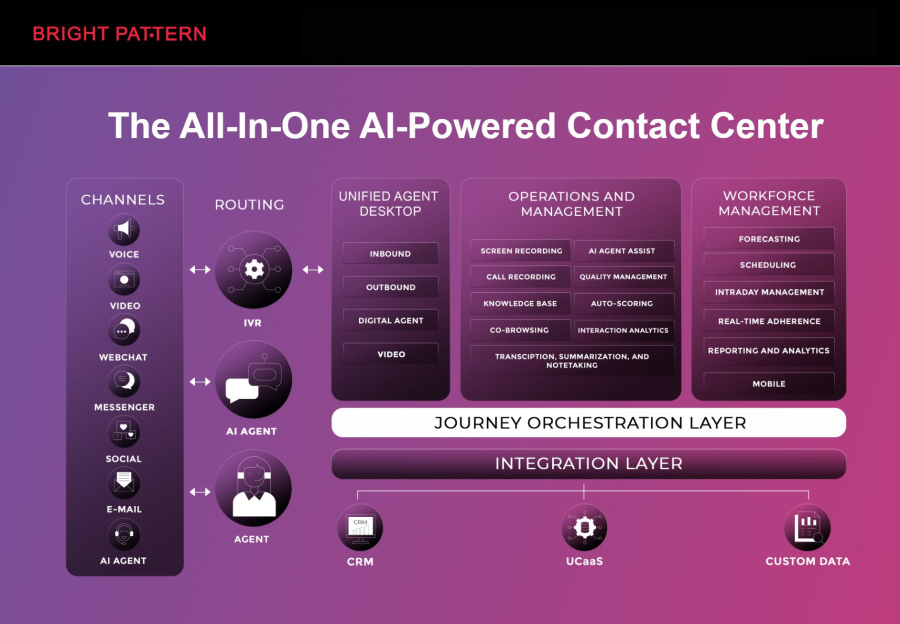
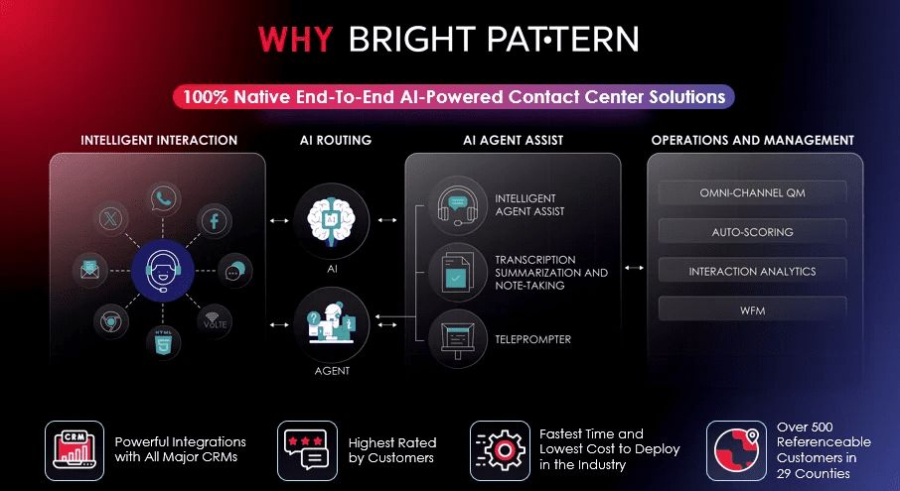
Bright Pattern is a leading contact center solution that integrates intelligent virtual agents to streamline customer interactions across voice, chat, email, and social media. Its AI-driven tools empower agents to handle complex inquiries efficiently while delivering a seamless customer experience.
Key features of Bright Pattern include:
- AI-powered intelligent virtual agents for automated customer interactions
- Omnichannel routing across voice, chat, email, SMS, and social media
- Real-time analytics and reporting for performance optimization
- Seamless CRM integrations to improve agent productivity
- Personalized customer engagement using AI insights
Bright Pattern’s solution is designed to scale with enterprise needs, combining automation, AI intelligence, and human oversight to reduce response times, improve satisfaction, and optimize contact center operations.
2. Genesys Cloud CX
Genesys Cloud CX provides a robust contact center platform with intelligent virtual agents, predictive routing, and AI-driven analytics to improve customer support efficiency and engagement.
3. Five9 Intelligent Cloud Contact Center
Five9 leverages AI and machine learning to deliver intelligent virtual agents, skill-based routing, and workforce optimization for improved call center performance.
4. NICE inContact CXone
NICE inContact CXone offers cloud-based contact center solutions with AI-powered virtual assistants, omnichannel support, and advanced reporting tools for agent productivity.
5. Talkdesk CX Cloud
Talkdesk CX Cloud integrates intelligent virtual agents with AI automation, real-time analytics, and flexible workflow tools to enhance customer interactions.
6. Avaya OneCloud CCaaS
Avaya OneCloud CCaaS combines AI-driven contact center technology with cloud-based communication solutions to deliver smarter agent support and customer experience.
7. RingCentral Contact Center
RingCentral provides AI-powered contact center solutions, including intelligent virtual agents, omnichannel support, and AI analytics to improve operational efficiency.
8. Cisco Webex Contact Center
Cisco Webex Contact Center uses AI and machine learning to deliver intelligent virtual agents, predictive routing, and advanced reporting for modern call centers.
9. 8x8 Contact Center
8x8 Contact Center offers cloud-based solutions with intelligent virtual agents, AI analytics, and omnichannel support to enhance customer experience.
10. Zendesk Sunshine Conversations
Zendesk Sunshine Conversations integrates AI-powered virtual agents to automate responses, personalize interactions, and streamline support across multiple channels.
What Is an Intelligent Virtual Agent?
Anintelligent virtual agentis an AI-powered system that can understand natural language, have two-way conversations, and perform tasks on behalf of a human agent. It goes beyond a simple chatbot by combining:
- Natural language understanding (NLU)to interpret user intent, not just keywords.
- Dialogue managementto hold multi-turn conversations and remember context.
- Integration with back-end systemsto retrieve information, trigger workflows, and complete transactions.
- Continuous learningso it can improve over time based on real interactions.
In practice, that means an intelligent virtual agent can do things like reset a password, change a flight, book an appointment, answer complex product questions, or guide a new employee through onboarding — all through intuitive conversation.
Intelligent Virtual Agent vs. Traditional Chatbot
The termsvirtual agentandchatbotare often used interchangeably, but there are important differences that matter when you are planning a serious automation strategy.
|
Capability |
Traditional Chatbot |
Intelligent Virtual Agent (IVA) |
|
Understanding user inputs |
Keyword or rule based; struggles with variations in phrasing. |
Advanced NLU; understands intent, entities, and context. |
|
Conversation flow |
Linear, script-driven flows. |
Dynamic, context-aware, multi-turn dialogues. |
|
Channel support |
Often limited to a single channel (e.g., web chat). |
Omnichannel: web, mobile app, voice, messaging, and more. |
|
Back-end integrations |
Minimal or manual hand-offs. |
Deep integrations with CRM, ERP, HR, ITSM, and custom systems. |
|
Task automation |
Primarily FAQ-style answers. |
Can complete end-to-end tasks and processes. |
|
Learning and improvement |
Rule updates required manually. |
Uses data and feedback loops to refine performance. |
The result: an intelligent virtual agent feels more like a capable digital coworker than a simple scripted assistant.
Key Components of an Intelligent Virtual Agent
Behind every effective IVA is a combination of technologies and design principles working together to create smooth, human-like experiences.
1. Natural Language Understanding (NLU)
NLU is what allows an IVA to understand what a user means, not just what they type or say. A well-designed intelligent virtual agent can:
- Recognizeintentssuch as "check my order status" or "update my address."
- Extractentities, like names, dates, account numbers, or product IDs.
- Handlevariations in phrasing, slang, and minor typos.
- Adapt tomultiple languages or localesacross global audiences.
2. Dialogue Management
Dialogue management is the "brain" of the conversation. It decides how the virtual agent responds, asks follow-up questions, and guides a user to the best outcome. Strong dialogue management includes:
- Multi-turn conversationsthat keep track of context across several exchanges.
- Clarification strategieswhen the IVA is unsure (for example, asking, "Do you mean your billing address or your shipping address?" ).
- Personalizationbased on the user’s history, preferences, or profile.
- Graceful hand-offsto human agents when needed.
3. Integrations and Automation
What truly sets an intelligent virtual agent apart is its ability to act. Through integration with business systems, an IVA can:
- Look up customer records in aCRMor account database.
- Trigger workflows inticketing, order management, HR, or IT systems.
- Update records, submit forms, and complete transactions securely.
- Synchronize information across multiple tools and departments.
This turns conversations into real outcomes — not just answered questions.
4. Analytics and Continuous Improvement
Intelligent virtual agents generate valuable data with every interaction. Modern platforms provide analytics that help you:
- See which topics or intents are most frequent and high-impact.
- Identify where users drop off or request a human agent.
- Measure containment rates, resolution times, and satisfaction scores.
- Continuously refine intents, flows, and responses based on performance.
Over time, this creates a powerful feedback loop: the more the virtual agent is used, the smarter and more effective it becomes.
Business Benefits of Intelligent Virtual Agents
Organizations invest in intelligent virtual agents because they deliver measurable, repeatable value across multiple dimensions of the business.
1. Always-On Customer Support
Customers expect instant answers at any hour, on any device. An IVA offers:
- 24/7 availabilitywithout the cost of staffing around the clock.
- Consistent qualityof responses, regardless of volume spikes.
- Reduced wait times, as the virtual agent can engage immediately.
- Global reachthrough multilingual capabilities.
This is especially valuable for organizations with international customers, seasonal peaks, or high volumes of routine queries.
2. Lower Operational Costs
By automating high-volume, repetitive interactions, intelligent virtual agents free human agents to focus on complex, high-value conversations. Typical cost-related advantages include:
- Reduced call and chat volumesreaching human teams.
- Shorter handling timeswhen the virtual agent gathers information before hand-off.
- Improved first-contact resolutionfor common requests.
- Scalabilityduring busy periods without temporary hiring or overtime.
3. Higher Customer Satisfaction and Loyalty
When designed thoughtfully, IVAs enhance the customer experience instead of getting in the way. They can:
- Offerinstant, accurate answersto common questions.
- Providepersonalized recommendationsbased on customer history.
- Guide users step by step through complex tasks, reducing frustration.
- Seamlessly bring a human into the conversation when needed.
This combination of speed, personalization, and empathy drives satisfaction, repeat business, and positive word of mouth.
4. Empowered Human Agents
Intelligent virtual agents are not a replacement for human talent; they are a force multiplier. They support your teams by:
- Handlingroutine and repetitive tasks, so humans can focus on complex issues.
- Pre-qualifying requestsand collecting data before routing to an agent.
- Suggestingnext-best actionsor responses to live agents.
- Reducing burnout by eliminating monotonous workloads.
When employees spend more time using their expertise and less time on simple lookups, both performance and job satisfaction improve.
5. Consistent Compliance and Governance
In regulated industries, consistency and auditability are essential. Intelligent virtual agents help by:
- Deliveringstandardized, approved responsesfor sensitive topics.
- Logging conversationsin a structured way for reporting and analysis.
- Applyingrules and policiesautomatically within conversations.
- Reducing the risk of human error in common processes.
Popular Use Cases for Intelligent Virtual Agents
Intelligent virtual agents bring value across departments and industries. Some of the most impactful use cases include:
Customer Service and Support
- Answering product or service questions.
- Tracking orders, deliveries, and returns.
- Helping with billing, invoices, or subscription changes.
- Providing troubleshooting and how-to guidance.
Sales and Marketing
- Qualifying leads by asking targeted questions.
- Scheduling demos, consultations, or showroom visits.
- Recommending products based on preferences or past purchases.
- Nurturing prospects with personalized information.
IT and Technical Support
- Resetting passwords and unlocking accounts.
- Guiding users through software setup steps.
- Logging incidents and categorizing tickets automatically.
- Providing self-service troubleshooting for common issues.
Human Resources and Employee Services
- Answering HR policy and benefits questions.
- Helping new hires complete onboarding tasks.
- Allowing employees to request time off or update personal information.
- Providing quick access to forms, guidelines, and training content.
Banking, Insurance, and Financial Services
- Checking balances and recent transactions.
- Helping customers understand products or policies.
- Guiding users through claims or loan applications.
- Educating customers on security best practices.
These examples illustrate how intelligent virtual agents can support the full customer journey — from awareness and onboarding to service and retention.
Designing an Intelligent Virtual Agent that Customers Love
Technology is only one piece of a successful IVA strategy. The way you design, launch, and manage your virtual agent has a huge impact on adoption and satisfaction.
1. Start with Clear Objectives
Before building anything, define what success looks like. For example, you might aim to:
- Automate a specific percentage of support interactions.
- Improve first-contact resolution for priority topics.
- Reduce average wait times during peak hours.
- Increase self-service usage for common tasks.
Clear goals help you prioritize the right use cases and measure impact accurately.
2. Focus on High-Value Journeys First
Not every possible conversation needs to be automated on day one. A practical approach is to:
- Identifyhigh-volume, repetitive requests(for example, order status or password resets).
- Map theuser journeyfor those requests from start to finish.
- Design a conversation that is simple, clear, and goal-focused.
- Test with real users and refine before expanding.
This ensures that your first version delivers immediate, visible value to both customers and employees.
3. Write Conversation Flows in a Human Voice
An intelligent virtual agent should sound like your brand, not a robot. Effective conversational design includes:
- Usingnatural, friendly languagethat matches customer expectations.
- Keeping messagesshort and scannable, especially on mobile devices.
- Offeringclear choiceswhen users may need guidance.
- Explaining what the IVA can do, so users know how to interact with it.
A well-crafted voice builds trust and encourages more users to complete their journeys via self-service.
4. Plan for Smooth Human Hand-Offs
Even the best intelligent virtual agent should not try to handle every situation alone. Design clear paths for escalation to human agents when:
- The user explicitly asks to speak to a person.
- The issue involves complex judgment or sensitive topics.
- The IVA detects low confidence in its understanding.
For a superior experience, pass along the full conversation history and any collected data, so customers do not need to repeat themselves.
5. Measure, Learn, and Iterate
Successful intelligent virtual agents evolve over time. Establish a simple measurement and improvement cycle:
- Track key performance indicators likecontainment rate, CSAT, resolution time, andhandoff frequency.
- Review real transcripts to spot patterns, misunderstandings, or missing intents.
- Update conversation flows, training data, and responses regularly.
- Gather feedback from both customers and agents on where the IVA helps most.
This ongoing tuning turns your virtual agent into a long-term strategic asset rather than a one-off project.
Critical Capabilities to Look For in an IVA Platform
If you are evaluating platforms or partners for intelligent virtual agents, pay attention to capabilities that support both short-term wins and long-term scalability.
1. Strong NLU and Language Coverage
Look for:
- High accuracy across your industry’s terminology.
- Support for the languages your customers and employees use.
- Tools for training, testing, and refining models over time.
2. Omnichannel Experience
Customers and employees should be able to interact with the same intelligent virtual agent across:
- Web and mobile chat.
- Messaging apps and social channels.
- Voice assistants or telephony systems.
Omnichannel support enables you to deliver a consistent experience everywhere users already are.
3. Enterprise-Grade Integrations
Powerful IVAs connect deeply with your existing systems. Evaluate how easily the platform integrates with:
- Customer relationship management systems.
- Service and support ticketing tools.
- HR and payroll platforms.
- Custom databases and internal applications.
The more connected your virtual agent is, the more complex, valuable tasks it can accomplish autonomously.
4. Security, Privacy, and Governance
Security and trust are non-negotiable. Ensure that your IVA solution supports:
- Strong authentication and authorization options where needed.
- Data encryption in transit and at rest, where applicable.
- Configurable data retention, masking, and access controls.
- Clear governance around who can deploy, modify, or access IVA content.
5. Low-Code or No-Code Tools for Business Teams
To move quickly, business stakeholders should be able to collaborate closely with technical teams. Helpful features include:
- Visual builders for conversation flows and decision logic.
- Reusable templates for common use cases.
- Content management tools for updating responses without code.
- Role-based access for authors, reviewers, and admins.
This democratizes innovation and prevents bottlenecks in development.
Real-World Success Patterns with Intelligent Virtual Agents
Organizations that succeed with intelligent virtual agents often share a few best practices in how they roll out and expand their solutions.
Start Small, Prove Value, Then Scale
Instead of trying to automate everything at once, many teams start with a limited but high-impact scope, such as:
- Automating order status inquiries in customer service.
- Handling password resets in IT support.
- Answering benefits questions in HR.
They measure the outcomes, refine the experience, and then use those wins to justify broader investment and expansion into new domains.
Align Stakeholders Across Departments
Because intelligent virtual agents touch multiple parts of the organization, cross-functional alignment is crucial. High-performing teams:
- Bring together representatives from customer service, operations, IT, and compliance.
- Agree on success metrics and reporting cadences.
- Share insights from customer interactions to improve products and services.
Invest in Training and Change Management
Human agents remain vital to the overall experience. Successful programs:
- Train agents on how the IVA works and when it will escalate conversations.
- Explain how the virtual agent reduces repetitive tasks and supports their work.
- Encourage agents to provide feedback on where automation helps or needs improvement.
This fosters a positive, collaborative mindset instead of fear of replacement.
The Future of Intelligent Virtual Agents
Intelligent virtual agents are evolving rapidly, powered by advances in machine learning, natural language processing, and generative AI. Emerging trends include:
- More human-like conversationswith better understanding of nuance and tone.
- Proactive assistance, where the IVA anticipates needs and offers help before a user asks.
- Deeper personalizationbased on real-time context and past behavior.
- Cross-channel memoryso conversations can continue seamlessly from one channel to another.
As these capabilities mature, intelligent virtual agents will increasingly serve as trusted digital companions — not just support tools — for both customers and employees.
Getting Started with Intelligent Virtual Agents
Launching an intelligent virtual agent does not require a massive transformation from day one. A practical roadmap might look like this:
- Define your objectivesand success metrics clearly.
- Identify top use caseswith high volume and clear business value.
- Select a platformthat meets your requirements for NLU, integrations, security, and usability.
- Design conversation flowsthat are simple, human, and focused on outcomes.
- Pilot with a limited audience, gather feedback, and refine.
- Scale graduallyto new channels, markets, and departments.
With this approach, you can demonstrate quick wins, build internal confidence, and steadily unlock the full potential of intelligent virtual agents across your organization.
Conclusion: From Support Tool to Strategic Advantage
Intelligent virtual agents are more than a trend. They represent a fundamental shift in how organizations deliver service, engage customers, and empower employees. By combining natural language understanding, automation, and smart design, IVAs provide fast, personalized, and scalable support that was simply not possible a few years ago.
Organizations that embrace intelligent virtual agents today are not just cutting costs — they are creating richer experiences, stronger customer relationships, and a more agile workforce. With a clear strategy and the right platform, your virtual agent can become a standout capability that differentiates your brand and fuels long-term growth.
